


12. 11. 2026
The anniversary edition of Interferences continues with performances by Lee Jaram, Josef Nadj, Luk Perceval, and Silviu Purcărete
The 10th anniversary edition of the Interferences International Theatre Festival continues with productions by South Korean Lee Jaram, world-renowned choreographer and dancer Josef Nadj, Flemish Luk Perceval, and Silviu Purcărete. From November 13 to 16, audiences will encounter a wide range of theatrical approaches, from Korean storytelling traditions to contemporary dance and the theater of the absurd, to family dramas and the world of the tales from One Thousand and One Nights. The program will also feature an album-release concert by the Lucian Ban & Elevation jazz ensemble, an exhibition opening, book launches, and meet-and-greets with the audience.
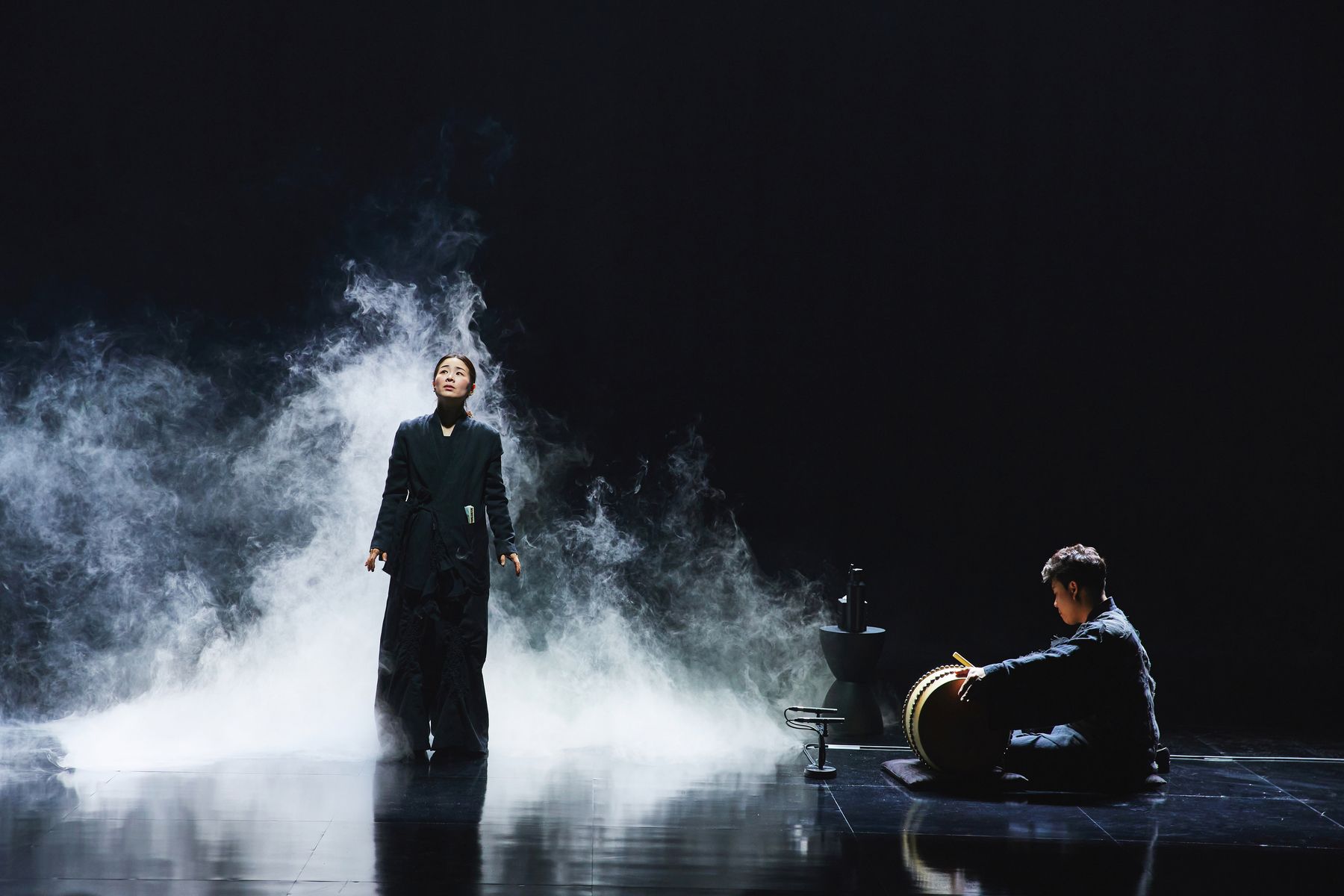
On Friday, November 13, at 8:00 p.m., audiences can see South Korean artist Lee Jaram’s performance titled Snow, Snow, Snow in the Main Hall of the Hungarian Theatre of Cluj. Returning to the festival for the fifth time, the artist is coming to Cluj-Napoca this time with an adaptation of Leo Tolstoy’s Master and Man. The text, adaptation, and music are by Lee Jaram, and the production was directed by Park Ji-hye. The performance is a co-production of the LG Arts Center and Wansung Playground.
Lee Jaram is one of the best-known contemporary representatives of the traditional Korean pansori genre. What makes pansori unique is that stories come to life through the collaboration of a single singer and a drummer: the performer brings the various characters to life using the tools of song, speech, and acting. Lee Jaram’s work blends centuries-old Korean tradition with classics of world literature.
The story of Snow, Snow, Snow takes place in 19th-century Russia during the Christmas holidays. Vasily, a wealthy merchant, sets out with his loyal servant, Nikita, to purchase a forest from which he hopes to reap significant profits. However, the two men repeatedly lose their way on the snow-covered roads, while the intensifying snowstorm and the darkness make their situation increasingly hopeless. The story focuses on themes of vulnerability, human relationships, and selfishness. Lee Jaram brings all the characters in the narrative to life herself, with the collaboration of drummer Lee Jun-hyoung.
On the same day, starting at 5:30 p.m., the Hungarian Theatre of Cluj, will also present its production of I Am Not Here in the Studio. The stage adaptation, based on Zsolt Karácsonyi’s novel Belső tízezer, was written by Kata Gyarmati and Kinga Mezei, directed by Kinga Mezei.
The play centers on an elderly man whose memories gradually become entangled, with his past and present blurring into one another, while he finds it increasingly difficult to maintain his sense of self. The story explores themes of memory loss, the passage of time, and the preservation of human relationships. Through theatrical visuals, music, and the actors’ performances, Kinga Mezei’s production depicts the inner world of a disintegrating consciousness, in which humor and imagination play an important role alongside moments of pain.
Friday’s program is further enriched by two accompanying events: the opening of Botond Részegh’s exhibition titled See? will take place at 1:00 p.m. at the Cluj-Napoca Art Museum. The exhibition is open through December 2, 2026, Wednesday through Sunday, between 10:00 a.m. and 5:00 p.m. Admission to the exhibition is free through November 22. Starting at 3:30 p.m., adult audience members who have seen the performance The Angel of the Hearth are invited to the Planetarium Café for a Hungarian-language theater education workshop titled What's It All About?.
On Saturday, November 14, the production Dialogues in the Dream by Josef Nadj — who hails from Vojvodina and creates in France — will be performed twice in the theater’s Studio: at 6 p.m. and 9 p.m. In a production by the Paris-based Atelier 3+1, Josef Nadj takes the stage with his longtime creative partner, Ivan Fatjó. This marks Josef Nadj’s ninth return to the festival.
Dialogues in the Dream explores the worlds of the unconscious and imagination through a wordless, dreamlike duet. In this production inspired by Japanese Zen, Central European surrealism, and the music of John Cage, the two performers appear in white masks and black hats, using their movements to explore the boundaries between the living and the inanimate, the human and the puppet, and reality and imagination.
In Josef Nadj’s work, the tools of dance, visual art, pantomime, and theater coalesce into a distinctive, easily recognizable theatrical language. Dialogues in the Dream is also a continuation of the artistic collaboration between Nadj and Fatjo that has been ongoing since 2007, in which the body and movement become the most important means of communication.
On Saturday, starting at 7:30 p.m., audiences can enjoy a performance of The Bald Prima Donna by the György Harag Company of the Northern Theater in Satu Mare in the main auditorium of the Lucian Blaga National Theater in Cluj-Napoca. Eugène Ionesco’s absurdist drama was directed by Gábor Tompa.
The play is seemingly built on everyday conversations, repetitive phrases, and increasingly absurd situations. The characters talk incessantly, while words gradually lose their meaning and communication becomes impossible. Ionesco’s work focuses on the emptiness of language, social conventions, and the absurdity of human relationships.
Saturday’s program will be complemented by an album release concert for Lucian Ban & Elevation’s RUSH, starting at 9:00 p.m. at Auditorium Maximum. The New York-based jazz ensemble features Lucian Ban on piano, Abraham Burton on tenor saxophone, John Hébert on double bass, and Nasheet Waits on drums. The concert’s special guest is singer Gavril Ţărmure.
Formed in 2006, Elevation’s new album is the result of the band’s two decades of collaboration. What makes RUSH unique is that, in addition to the American jazz tradition and contemporary musical experimentation, it also incorporates the folk music heritage of Transylvania. The album concludes with a rendition of an old Transylvanian folk song, Sárgarigó, sárgás toll, in which Gavril Țărmure’s traditional vocals blend with the sound of the Elevation quartet.
On Sunday, November 15, at 5:00 p.m., the Camil Petrescu Cultural Foundation will hold a book launch in the upstairs foyer of the Hungarian Theatre of Cluj, where audiences can discover three specialized theater publications. Among the publications featured is the Romanian-Hungarian bilingual volume by Jean-Guy Lecat, former collaborator of world-renowned set designer Peter Brook, titled A Performance, An Audience, A Single Space, Milo Rau’s The Art of Resistance, which examines questions of theater’s social and political responsibility, as well as Jacques Lecoq’s The Poetic Body: Lessons on Theatrical Creation.
Also on Sunday, starting at 7 p.m., the Kraków-based Helena Modrzejewska National Theater – Stary Teatr will present Once Upon a Long Day in the Main Hall of the Hungarian Theatre of Cluj. The production is based on Eugene O’Neill’s Long Day’s Journey Into Night, directed by Luk Perceval.
The Flemish-born director is a leading figure in contemporary European theater; throughout his career, he has served as artistic director of the National Theater of Antwerp, guest director at Berlin’s Schaubühne, and chief director at Hamburg’s Thalia Theater. His work has been honored with numerous prestigious international awards, including the 2013 Faust Prize, the 2014 Golden Mask Award, and the 2021 Konrad Swinarski Prize.
O’Neill’s autobiographically inspired drama is one of the defining works of American theatrical literature. Written in 1941, the play was not permitted to be published during the author’s lifetime and was not staged until 1956, three years after his death. O’Neill was posthumously awarded the Pulitzer Prize for the play.
The production has received numerous professional accolades: Małgorzata Zawadzka won several prestigious acting awards for her portrayal of Mary Tyrone, and Roman Gancarczyk received the same honors for his portrayal of James Tyrone, while Luk Perceval was awarded the Maciej Prus Honorary Prize for Best Director at the 2024 Kalisz Theater Festival.
On Monday, November 16, at 6:00 p.m., spectators can view The Maids. Materials by the Polish Wachowicz/Fret Studio and the Grotowski Institute in Wrocław in the theater’s Studio. The production was directed by Jarosław Fret and is based on Jean Genet’s play The Maids. In addition to Genet’s work, the production also incorporates excerpts from texts by Jean-Pierre Siméon and Dimitris Dimitriadis, as well as from the Constitution of the French Republic.
The performance leads the audience into the world of a refugee shelter, where women from various countries attempt to define their own identities through games and personal stories. The characters communicate in a language that takes shape before the audience’s eyes, while questions of identity and dignity become increasingly prominent.
On the same day, starting at 8:00 p.m., the Radu Stanca National Theater in Sibiu will present The Incomparable Story of Abul Hassan the Yemeni and His Flight into the Desert (Based on One Thousand and One Nights) in the theater’s Main Hall. The production was directed by Silviu Purcărete, with set and costume designs by Dragoș Buhagiar and original music by Vasile Șirli.
This time, Silviu Purcărete draws inspiration from the world of the One Thousand and One Nights, bringing to the stage a story that has almost been forgotten. The starting point is a lost tale that the sultan — though weary of stories — nevertheless wishes to discover from a childlike sense of curiosity. The rediscovery of this story marks the beginning of a theatrical adventure in which the joy of storytelling and the freedom of imagination take center stage.
The director uses music, rhythm, movement, and improvisation to create the rich, sensual world of One Thousand and One Nights. The actors take on the roles of storytellers, musicians, spirits, or characters in the story, as various sounds and narrative threads intertwine. The production combines the atmosphere of Eastern fairy tales with the visual imagery and playfulness of contemporary theater.
The festival is co-organized by the Corvineum Foundation, with main sponsors including the Ministry of Culture, the European Theater Union, and the Mayor’s Office and City Council of Cluj-Napoca.
The event is made possible with the support of the Office for Interethnic Relations, the Communitas Foundation, Energobit, the Cluj County Council, as well as the Government of Hungary and the Bethlen Gábor Fund.
Transportation partner: RMB Inter Auto.
Institutional partners: Cluj-Napoca National Theater, Cluj-Napoca Romanian Opera, the Cluj-Napoca Museum of Art, Babeș-Bolyai University, the Cluj-Napoca Transilvania State Philharmonic, and MOME.
The detailed program of the festival can be found on the official website of the Interferences International Theatre Festival, at interferences-huntheater.ro/2026/.
All performances feature Hungarian, Romanian, and English subtitles!
Tickets for the performances in the festival program can be purchased online at huntheater.biletmaster.ro, as well as at the theater's box office, which will be open from November 10–22 on an exceptional basis from 10:00 a.m. until the start time of the evening's last performance.
The theater reserves the right to make changes to the program!
Menu
Home
Program
About us
The Company
Tickets
Public information
Data protection information
Our partners
Contact
| Address | Str. E. Isac nr. 26-28, 400023 Cluj-Napoca, România |
| Phone | +40-264-439204 |
| Fax: | +40-264-236125 |
Subscribe to our Newsletter!
Follow us


