


14. 04. 2026
The Hungarian Theatre of Cluj premieres György Spiró’s Black Out
On Thursday, April 16, at 8 pm, the premiere of Black Out based on György Spiró’s play, will take place in the theater’s Studio. The production was directed by Vlad Massaci, who is collaborating with the Cluj company for the first time. Upcoming performances: April 23 and 26, with additional performances scheduled for May and June, all starting at 8 pm.
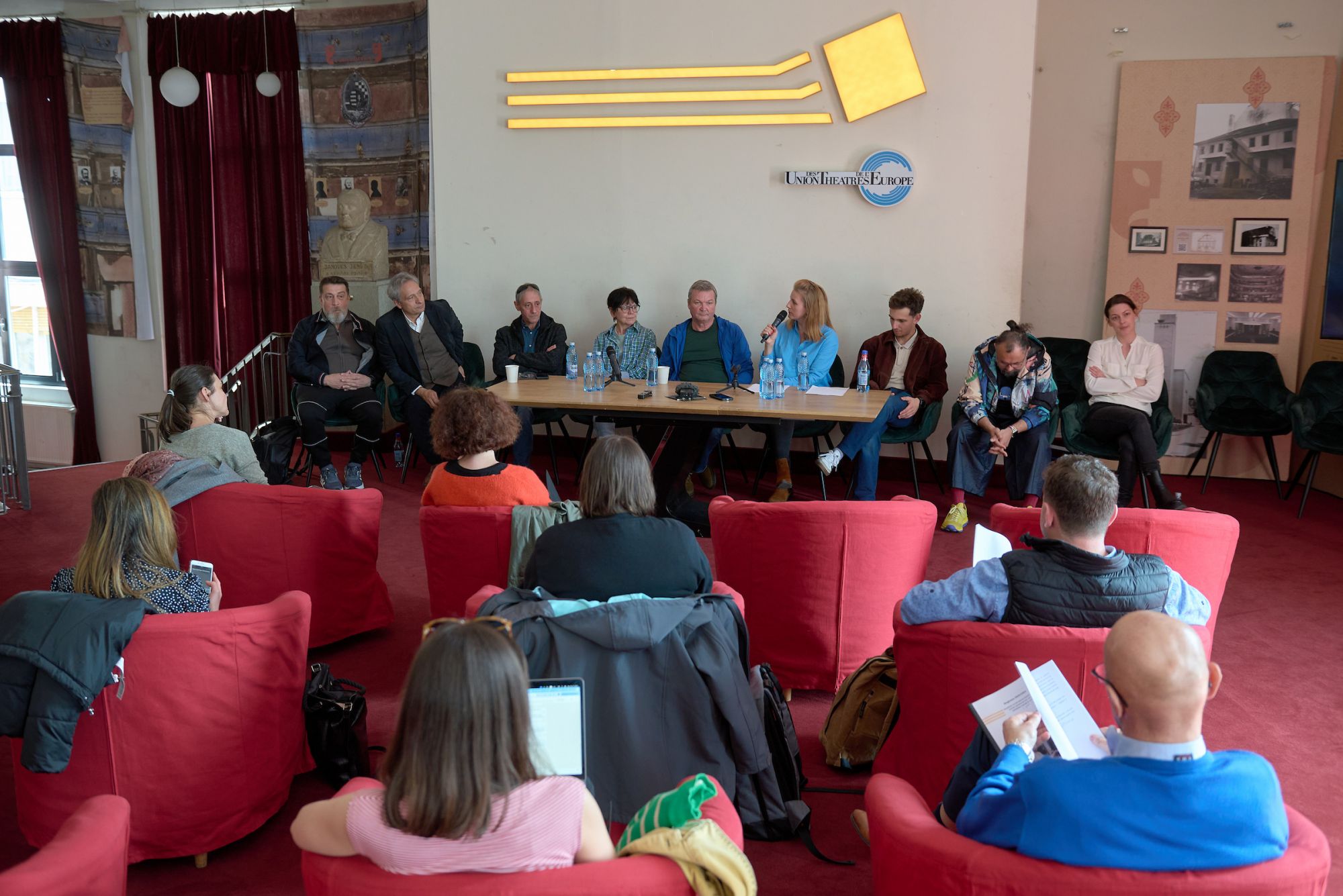
At the press conference preceding the premiere, dramaturg Noémi Vajna welcomed the production’s creators and then briefly summarized the plot of the play: “György Spiró’s play is set in July 1941, in Budapest, during the air raid blackout. The life of a married couple changes radically over the course of a few hours when the Third Jewish Law comes into effect. According to Imre Kertész, the play is about the same thing as the history of our own time: the conflict between destructive madness and creative reason.”
Vlad Massaci, the director of the production, had this to say about Spiró’s play: “This is a text I became familiar with around the time it was written, sometime in 2001–2002, and which made a deep impression on me from the very first reading. I am particularly interested in plays that construct borderline situations defined by moral decisions. I also really love the play’s language. I read the text in German, and although I cannot claim to have a complete command of the language, the structural rigor of the drama is still clearly perceptible—a sort of backbone in a chaotic world. I am aware that, in a theatrical sense, the performance may seem difficult to grasp and, at times, static. The true dynamics, however, unfold on the level of ideas, which are in constant motion and transformation. I am convinced that every sensible viewer can recognize the text’s deep connection to the present day.”
Maria Miu, the production’s set and costume designer, described the visual aesthetic of the performance as follows: “I tried to create a space full of tension and uncertainty that constantly suggests the threat of the outside world. It is not an apartment in the concrete sense, but rather a subliminal, liminal space situated on the border between reality and imagination. The space also has a poetic dimension, though this poetry is likewise saturated with tension. My primary goal was to use this space to reinforce the director’s concept and the message of the performance.”
The performance’s composer, Vlaicu Golcea, said the following regarding the soundscape: “My initial approach—as is usually the case—was rather dismissive this time as well: I believe that when a text is this powerful, it is difficult for music to find its place within it. My attitude toward the presence of music in theater is fundamentally ambivalent. In this case, however, the text is impressive not only in content but also in form: it is extremely dense, the speech is continuous, so the channel of communication—the human voice and the word—had to be preserved with particular care.
Accordingly, I conceived the soundscape in a more conceptual and functional vein, avoiding any solution that might become illustrative or intrusive. The music must not obscure or overpower the actors’ voices, especially in such an intimate, almost chamber-like setting, where the audience feels as though they are in the characters’ personal space.
Thus, I envisioned the musical material as a kind of “emotional conduit”: an invisible current that does not duplicate the action, but rather permeates the audience. There is no recognizable musical aesthetic, no themes or melodies in the traditional sense, only a succession of states that appear and disappear, just like human emotions.”
The two lead roles in the performance are played by Áron Dimény and Éva Imre, with Zsolt Bogdán, Róbert M. Kardos, and Gergő Biró appearing in supporting roles.
Contributors to the production include set and costume designer Maria Miu and composer Vlaicu Golcea.
The production was supported by the Government of Hungary and the Bethlen Gábor Fund.
Tickets for the premiere of Black Out are already sold out; tickets for subsequent performances can be purchased at the theatre's box office (weekdays between 10 am and 2 pm) and online at huntheater.biletmaster.ro.
Menu
Home
Program
About us
The Company
Tickets
Public information
Data protection information
Our partners
Contact
| Address | Str. E. Isac nr. 26-28, 400023 Cluj-Napoca, România |
| Phone | +40-264-439204 |
| Fax: | +40-264-236125 |
Subscribe to our Newsletter!
Follow us


